
Introduction
You've built your HTML5 game. The mechanics are tight, the art looks great, and your friends can't stop playing it. Now comes the real question every developer eventually asks:
How do I actually make money from this?
Monetizing HTML5 games in 2026 is both an art and a science. Unlike native mobile apps locked inside the walled gardens of the App Store or Google Play, HTML5 games give you the freedom to distribute, license, and earn revenue across dozens of platforms simultaneously — without giving 30% of every dollar to a tech giant.
But freedom comes with complexity. There's no single "right" way to monetize an HTML5 game. The best strategy depends on your game's genre, audience, traffic volume, and the platforms you choose to publish on.
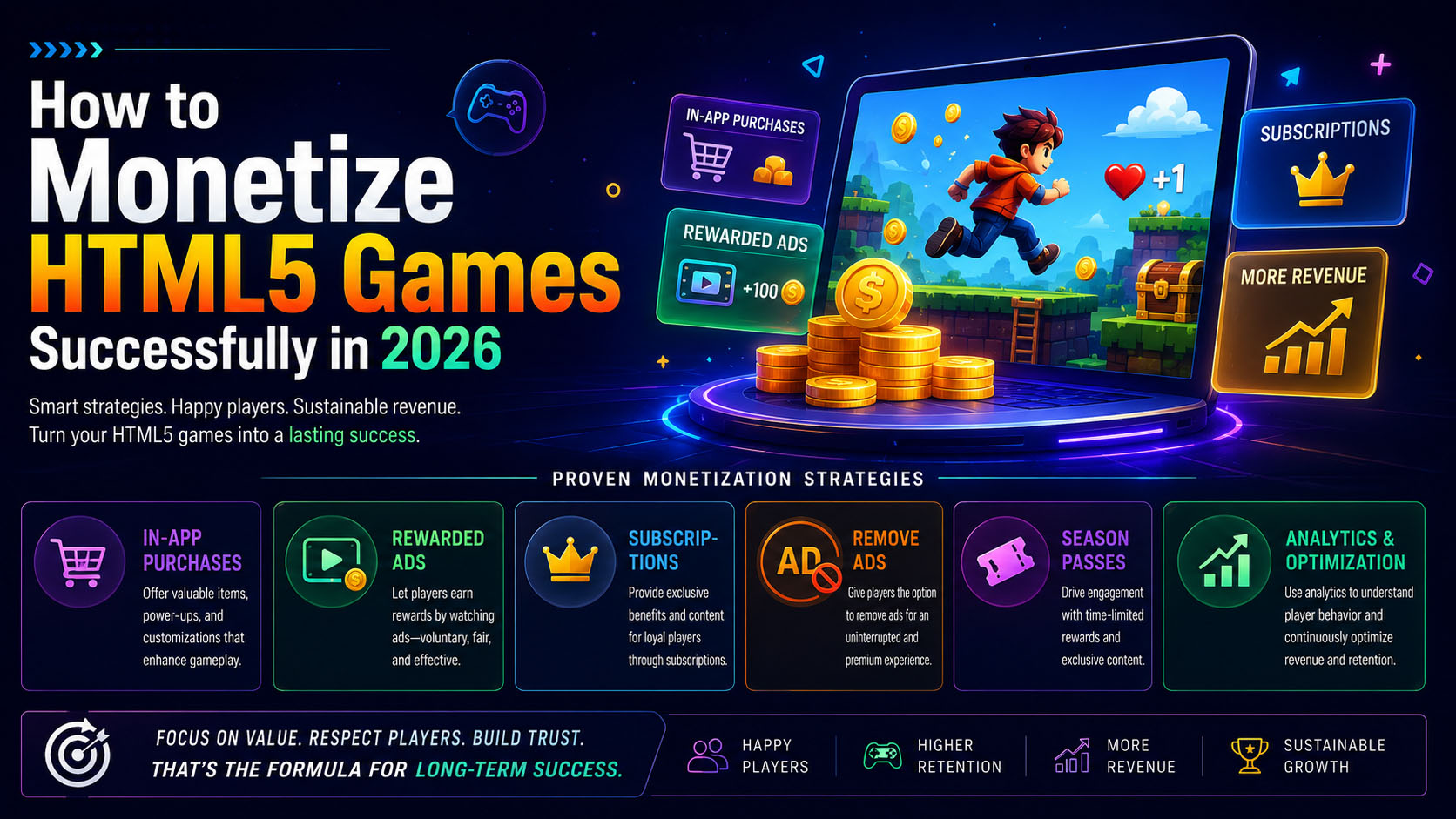
This guide breaks down the five most effective HTML5 game monetization strategies in 2026 — with actionable advice on how to implement each one, which platforms to use, and how to maximize your earnings from day one.
Table of Contents
- In-Game Advertising: The Foundation of HTML5 Monetization
- Rewarded Video Ads: The Highest-Performing Ad Format
- Sponsorships: Premium Deals for High-Traffic Games
- Licensing Game Source Codes: Sell Once, Earn Forever
- Publishing on Portals: Playgama, GameDistribution & CrazyGames
- Building a Multi-Revenue Stack: Combining Strategies
- Common Monetization Mistakes to Avoid
- Conclusion
1. In-Game Advertising: The Foundation of HTML5 Monetization {#in-game-advertising}
In-game advertising is the backbone of HTML5 game revenue. For most developers, it's the first monetization method they integrate — and for good reason. It requires no payment infrastructure, no user accounts, and no friction for the player. You simply show ads; you earn money.
Types of In-Game Ads
Understanding which ad format to use — and when — is critical to maximizing revenue without ruining the player experience.
Interstitial Ads
Interstitial ads are full-screen ads displayed at natural transition points in the game — between levels, after a game over, or when opening a menu. They're the most common format in HTML5 games and typically yield solid CPMs (cost per thousand impressions) because of their high visibility.
Best practice: Show interstitials no more than once every 60–90 seconds of gameplay. Overexposure kills retention, and poor retention kills long-term ad revenue.
Banner Ads
Banner ads are static or animated display ads placed around the game canvas — usually above, below, or beside it. They're passive and low-friction but generate significantly lower CPMs than interstitials or rewarded videos.
Best practice: Use banners as a supplementary revenue layer, not your primary income source. They're best on desktop, where the screen real estate exists to display them without crowding the game.
Playable Ads
This is an emerging and exciting format: your HTML5 game itself becomes the ad unit. Advertisers pay to use interactive mini-game experiences as ads across their campaigns. Playable ads command CPMs 3–5x higher than standard display ads because engagement rates are dramatically higher.
Best practice: If your game has a compelling 30–60 second experience, pitch it to ad networks like Google Ads or IronSource as a playable ad format.
Top Ad Networks for HTML5 Games
Network
Strengths
Best For
Google AdSense / Ad Manager
Massive demand, reliable payments
General web traffic
GameDistribution SDK
Built for HTML5 games
Portal-published games
CrazyGames SDK
High game-specific CPMs
Games on CrazyGames
Adinplay
Strong HTML5 game focus
Mid-size game sites
Appodeal
Mediation across multiple networks
Maximizing fill rates
CPM Benchmarks in 2026
CPMs for HTML5 game ads vary significantly by geography, genre, and season. As rough benchmarks:
- US/CA/UK/AU traffic: $3–$12 CPM (interstitials), $8–$25 CPM (rewarded video)
- European traffic: $2–$8 CPM
- Emerging markets (Asia, Latin America, Africa): $0.50–$3 CPM
- Q4 (Oct–Dec): CPMs typically spike 30–60% due to holiday advertiser demand
Key Takeaway: In-game advertising is the most accessible monetization method for HTML5 games, but placement strategy and ad network selection have an enormous impact on actual earnings. Never rely on a single network — use a mediation layer to maximize fill rates and CPMs.
2. Rewarded Video Ads: The Highest-Performing Ad Format {#rewarded-video-ads}
If you could implement only one monetization feature in your HTML5 game, it should be rewarded video ads.
What Are Rewarded Video Ads?
Rewarded video ads are opt-in video advertisements where the player voluntarily watches a 15–30 second video in exchange for an in-game reward — an extra life, a coin boost, a power-up, or access to premium content.
The key word is voluntary. Because the player initiates the ad themselves, the psychological dynamic is completely different from forced interstitials:
- Players don't feel interrupted or frustrated
- Completion rates are extremely high (80–95%, compared to 40–60% for interstitials)
- Post-ad player sentiment is positive — they just received something valuable
- Advertisers love the format because engagement is genuine
This combination of high completion rates and positive sentiment means rewarded video ads consistently deliver the highest CPMs of any HTML5 ad format.
How to Implement Rewarded Video Ads Effectively
Design Your In-Game Economy Around Them
The most successful rewarded video implementations are those where the reward feels meaningful but not pay-to-win. Examples:
- "Watch a video to revive and continue your run"
- "Watch a video to double your coin earnings for this level"
- "Watch a video to unlock a bonus level"
- "Watch a video to speed up your upgrade timer by 1 hour"
These create genuine player value while generating premium ad revenue.
Trigger Points Matter
Show the rewarded video prompt at high-stakes moments — right after a game over, just before a difficult boss, or when a player is one coin short of an upgrade. These are the moments where players are most motivated to engage.
Don't Force It
The moment rewarded video stops being optional, you've lost the magic. Always make the reward optional and make the alternative path (playing without the reward) still enjoyable.
Rewarded Ads vs. Interstitials: The Revenue Comparison
Metric
Interstitial Ads
Rewarded Video Ads
Player-initiated
❌ No
✅ Yes
Completion rate
40–60%
80–95%
Average CPM (US)
$3–$8
$8–$25
Player sentiment
Neutral/negative
Positive
Impact on retention
Can hurt retention
Often improves retention
Best SDKs for Rewarded Video in HTML5 Games
- IronSource (Unity LevelPlay) — industry-leading mediation with strong HTML5 support
- GameDistribution Rewarded Ads — purpose-built for HTML5 game portals
- Google IMA SDK — reliable and widely supported
- Playgama Monetization SDK — excellent for games published on Playgama's network
Key Takeaway: Rewarded video ads are the most player-friendly and highest-earning ad format available to HTML5 developers. Build your game's economy around them intentionally — the difference in revenue between a poorly-placed and a well-designed rewarded ad system can be 3–5x.
3. Sponsorships: Premium Deals for High-Traffic Games {#sponsorships}
Sponsorships are the premium tier of HTML5 game monetization — fewer developers use them, but those who do often earn far more per deal than they would through programmatic advertising alone.
What Is a Game Sponsorship?
A sponsorship is a deal where a brand or platform pays you — upfront or on a revenue-share basis — to have their branding featured in or associated with your game. This can take several forms:
Exclusive Sponsorship A single brand pays for exclusive rights to have their logo on the game's title screen, loading screen, and/or in-game elements. The game may be rebranded entirely (e.g., "Gem Blast, presented by BrandX"). This is the most lucrative form.
Non-Exclusive Sponsorship Multiple brands sponsor the same game. Each gets visibility, but no exclusivity. Lower per-deal value, but you can stack multiple sponsors simultaneously.
Portal Sponsorship A game portal like Miniclip, CrazyGames, or Kongregate pays for the exclusive right to host your game (or to be the first portal to host it). In exchange, you receive an upfront payment and/or a favorable revenue share.
Brand-Integrated Games A company commissions you to build a custom branded game — featuring their characters, products, or IP — for use on their website or social media. This is essentially freelance game development, but it can command $5,000–$100,000+ depending on the scope and the brand's budget.
Where to Find Sponsorships
FGL (Flash Game License — now HTML5-focused) One of the oldest and most established marketplaces for game sponsorships. Developers list their games; sponsors bid on them. Historically, top games on FGL have sold exclusive sponsorships for $1,000–$10,000+.
Direct Outreach If your game has significant traffic (100,000+ monthly players), brands in relevant verticals will often pay for sponsorship access. Build a media kit with your player stats, session duration, demographic data, and geographic breakdown — then pitch directly to brand marketing managers.
Game Publishers and Aggregators Companies like Softgames, Lagged, and Spil Games sometimes offer upfront licensing fees that function similarly to sponsorships, giving you a lump-sum payment in exchange for distribution rights.
How to Make Your Game Sponsorship-Ready
Before approaching sponsors, ensure your game:
- Has a clean title screen with a designated space for branding (logo, tagline)
- Includes a loading screen that can display sponsor content
- Has polished production quality — brands will not associate themselves with rough or buggy games
- Has measurable analytics — sponsors want to know how many people will see their brand
Key Takeaway: Sponsorships require more hustle to secure but pay significantly more per deal than programmatic ads. If your game has quality and traffic, even one sponsorship deal per quarter can transform your revenue outlook.
4. Licensing Game Source Codes: Sell Once, Earn Forever {#licensing-game-source-codes}
Licensing your HTML5 game's source code is one of the most underrated and potentially most lucrative monetization strategies available to developers.
How Game Licensing Works
Instead of (or in addition to) distributing your game publicly, you sell other parties the right to use, modify, and deploy your game code. Licensing comes in several flavors:
Non-Exclusive Portal Licensing You grant a game portal the right to host and distribute your game (without exclusive rights), typically in exchange for a revenue share or flat licensing fee. Because you retain rights, you can license the same game to dozens of portals simultaneously — stacking revenue from each.
Exclusive Licensing A single buyer pays a premium for exclusive rights to your game — meaning no one else can host, sell, or distribute it during the license term. Exclusivity commands a much higher price: exclusive licenses for quality HTML5 games typically range from $500 to $10,000+.
Source Code Licensing / White-Labeling You sell the underlying source code — allowing the buyer to rebrand, customize, and redeploy the game under their own identity. This is especially popular with:
- Brands wanting a custom-branded game for their website or campaign
- Ad agencies building playable ad units for clients
- Smaller studios that want a proven game template to build upon
- Educational platforms seeking gamified learning tools
Template Licensing on Marketplaces You publish your game's source code on marketplaces like CodeCanyon (Envato Market), itch.io, or GameDev Market as a purchasable template. Buyers pay a one-time fee (typically $15–$150) for the code, and you earn royalties on every sale — completely passively.
The Economics of Source Code Licensing
Let's say you build a well-polished HTML5 game in 6 weeks. You can:
- Sell non-exclusive licenses to 10 portals at $100–$500 each = $1,000–$5,000 upfront
- List the source code on CodeCanyon at $49 per sale — 50 sales/month = $2,450/month passively
- Sell one exclusive white-label deal to a brand for $5,000–$15,000
- Continue earning advertising revenue from portals where you distributed non-exclusively
The same game, built once, becomes four separate revenue streams.
Tips for Maximizing Licensing Revenue
- Build modular, clean code — buyers are willing to pay more for well-documented, easy-to-customize source code
- Create a professional README with setup instructions, file structure explanations, and customization guides
- Include a demo video showing the full game with all features — this dramatically increases conversion rates on marketplaces
- Offer customization as a paid add-on — list the source code at a base price, then offer custom branding/modification services as premium packages
Key Takeaway: Licensing transforms your game from a product into a platform for ongoing revenue. A single well-built game can generate income across portals, marketplaces, and direct deals simultaneously — with minimal ongoing effort after the initial build.
5. Publishing on Portals: Playgama, GameDistribution, and CrazyGames {#publishing-on-portals}
Game portals are the distribution backbone of the HTML5 gaming ecosystem. Publishing on the right portals puts your game in front of millions of players — and generates revenue through advertising and licensing simultaneously.
Here's a deep dive into the three most important portals for HTML5 game developers in 2026:
Playgama
Website: playgama.com
Monthly Players: 30M+
Revenue Model: Revenue share on advertising
Playgama has emerged as one of the fastest-growing HTML5 game networks of the past two years. What sets it apart is its developer-friendly approach and its focus on quality over quantity.
Key Features:
- Higher revenue share than many competing portals — Playgama is known for offering competitive splits to developers, particularly for exclusive or first-publish deals
- Playgama Bridge SDK — a lightweight, easy-to-integrate SDK that handles advertising, analytics, leaderboards, and social features across all platforms where Playgama distributes your game
- Multi-platform distribution — games published through Playgama's network are distributed not just on Playgama itself, but across dozens of partner platforms, multiplying your reach without additional work
- Strong analytics dashboard — detailed player data helps you understand engagement and optimize monetization
- Active developer community with responsive support
Best For: Developers who want strong revenue shares, broad distribution reach, and a modern SDK experience. Particularly good for developers publishing casual and hyper-casual titles.
Pro Tip: Submit your game as an exclusive or "first publish" to Playgama — they offer better terms for exclusives, and the additional reach from their partner network often compensates for any exclusivity period.
GameDistribution
Website: gamedistribution.com
Monthly Players: 400M+ (across network)
Revenue Model: Revenue share + licensing fees
GameDistribution is the largest HTML5 game distribution network in the world by reach. Rather than a single portal, it's a B2B platform that connects game developers with a network of 2,000+ publisher websites that host HTML5 games.
Key Features:
- Massive scale — 400M+ monthly players across partner sites is unmatched in the HTML5 space
- GameDistribution SDK — a standardized SDK for ads (display, interstitial, rewarded video), leaderboards, and social sharing that works across all network partners
- Non-exclusive model — submitting to GameDistribution doesn't prevent you from also publishing elsewhere, making it an excellent "always-on" base layer for your distribution strategy
- Licensing marketplace — brands and publishers can license games directly through the platform, opening sponsorship and white-label deal flow without the developer needing to do direct outreach
- Detailed reporting — impressions, clicks, plays, and revenue breakable down by game, partner, geography, and ad format
Revenue Share: GameDistribution typically operates on a 50/50 revenue split with developers, though this can be negotiated for high-performing games.
Best For: Any HTML5 developer who wants maximum distribution reach with minimal setup. GameDistribution should be in every developer's publishing stack — it's essentially free distribution to hundreds of partner sites.
Pro Tip: Integrate the GameDistribution SDK before submitting — games with the SDK integrated are prioritized in their network and earn significantly more than those without it.
CrazyGames
Website: crazygames.com
Monthly Players: 100M+
Revenue Model: Revenue share on advertising
CrazyGames is the most player-facing portal on this list — a massive, consumer-oriented gaming platform with a highly engaged audience. Getting featured on CrazyGames is a meaningful achievement for any HTML5 developer and can drive tens of thousands of plays per day.
Key Features:
- Premium player base — CrazyGames' audience is predominantly 18–35, with strong US, European, and LATAM representation, which translates to higher CPMs than average
- Quality bar is high — CrazyGames has an editorial review process and only accepts polished, well-designed games. This quality filter is what keeps their CPMs elevated and their player base engaged
- CrazyGames SDK — handles interstitial and rewarded video ads optimized for their platform, plus analytics and achievement systems
- Featured placement opportunities — games that perform well are highlighted on the homepage and in category pages, delivering massive organic traffic spikes
- Long-tail visibility — good games on CrazyGames continue to receive traffic and revenue for years after publishing
Revenue Share: CrazyGames' standard split is 50/50, with better terms possible for exclusive early access or high-quality submissions.
Best For: Developers with polished, complete games who want exposure to a large, high-quality player base with strong CPMs. Not ideal for rough or experimental builds — the quality review will reject them.
Pro Tip: Before submitting to CrazyGames, spend extra time on your game's thumbnail art and title — these are what drive click-through rates in their game library, and CrazyGames explicitly prioritizes games with compelling visual presentation.
Portal Comparison at a Glance
Portal
Monthly Reach
Revenue Model
Quality Bar
SDK Required
Best For
Playgama
30M+
Rev share
Medium-High
Yes (Playgama Bridge)
Dev-friendly rev share
GameDistribution
400M+
Rev share + licensing
Medium
Yes (GD SDK)
Maximum reach
CrazyGames
100M+
Rev share
High
Yes (CG SDK)
Premium CPMs
The Smart Publishing Strategy: Don't Choose One — Use All Three
The beauty of HTML5 game portals (unlike app stores) is that most operate on non-exclusive terms, meaning you can publish the same game to Playgama, GameDistribution, and CrazyGames simultaneously. Each portal becomes an independent revenue stream — same game, multiplied earnings.
A typical distribution stack for a well-performing HTML5 game:
- GameDistribution — for maximum breadth of reach across 2,000+ partner sites
- CrazyGames — for high-CPM, engaged audience traffic
- Playgama — for strong revenue share and partner network distribution
- Poki, Coolmath, Miniclip — additional portals for incremental traffic
- Your own website — where you keep 100% of ad revenue
Key Takeaway: Publishing on multiple portals simultaneously is the single highest-leverage action a new HTML5 developer can take. Each portal is an independent distribution channel — use them all.
6. Building a Multi-Revenue Stack: Combining Strategies {#multi-revenue-stack}
The most successful HTML5 game developers in 2026 don't rely on a single monetization method. They build layered revenue stacks where each strategy reinforces the others.
Here's what a mature HTML5 game monetization stack looks like:
REVENUE STREAM SETUP EFFORT MONTHLY POTENTIAL ────────────────────────────────────────────────────────── Portal ad revenue Medium $500 – $5,000+ (GameDist, CrazyGames, Playgama) Rewarded video ads Medium Included above, 2–3x uplift (integrated into portals) Own website traffic Medium-High $200 – $2,000+ (100% ad revenue retained) Source code licensing Low $300 – $3,000+ (CodeCanyon, direct) Sponsorship deals High $500 – $10,000+ per deal Branded game commissions Very High $5,000 – $50,000+ per project
Start with portal publishing and in-game ads — these generate revenue immediately with minimal friction. As traffic grows, layer in source code licensing and actively pursue sponsorship conversations. Once you have multiple successful titles in your portfolio, branded game commissions become accessible.
7. Common Monetization Mistakes to Avoid {#common-mistakes}
Even experienced developers leave money on the table. Watch out for these pitfalls:
Mistake 1: Over-advertising early players
Bombarding new players with ads before they've experienced the core gameplay loop destroys retention. Give players at least one complete gameplay session before showing an interstitial. Lifetime ad revenue depends on lifetime player retention.
Mistake 2: Publishing exclusively to one portal
Unless you're receiving a substantial exclusivity fee, locking your game into a single portal surrenders massive revenue potential. Most portals allow non-exclusive distribution — use it.
Mistake 3: Skipping the SDK integration
Submitting games to portals without their SDKs integrated results in lower priority placement, fewer feature opportunities, and lost rewarded video revenue. Always integrate the relevant SDK before submission.
Mistake 4: Neglecting game thumbnail and description
Your game's thumbnail is its storefront. A poorly-designed thumbnail on CrazyGames or GameDistribution will tank your click-through rate, regardless of how good the game is. Invest time in compelling key art.
Mistake 5: Building for a single genre
Casual games (puzzles, runners, arcade) consistently outperform niche genres on advertising-based portals because they attract broader demographics. If your goal is ad revenue, build for the widest possible audience.
Mistake 6: Ignoring analytics
Most portal SDKs provide detailed analytics. Developers who regularly review session length, drop-off points, and ad engagement — and iterate based on that data — consistently outperform those who don't.
8. Conclusion {#conclusion}
Monetizing HTML5 games in 2026 is genuinely exciting. The ecosystem has matured significantly — the tools are better, the platforms are more developer-friendly, and the audience is larger than ever.
The core principles remain simple:
1. Diversify your revenue streams — ads, licensing, sponsorships, and portals are all viable and complementary.
2. Publish everywhere you can — Playgama, GameDistribution, and CrazyGames should all be in your publishing stack.
3. Design monetization into your game — rewarded video works best when it's built into the core loop, not bolted on afterward.
4. Build quality first — the portals with the highest CPMs (CrazyGames, Poki) have quality bars. Meeting them unlocks premium revenue.
5. Think long-term — a good HTML5 game generates revenue for years. Time invested upfront in polish and monetization design pays compounding dividends.
The HTML5 game developer who treats their game as a business — not just a creative project — has every tool they need to build a sustainable, scalable income in 2026 and beyond.
Build it. Publish it everywhere. Then build it again.
Frequently Asked Questions (FAQ)
Q: How much money can an HTML5 game realistically make?
A: It varies enormously. A casual game on CrazyGames and GameDistribution might earn $100–$500/month passively. A hit game can earn $5,000–$20,000+/month across all revenue streams. Source code licensing and sponsorships can add significant lump sums on top.
Q: Do I need to integrate different SDKs for each portal?
A: Yes, but most SDKs are lightweight and share similar integration patterns. Playgama's Bridge SDK is designed to simplify multi-platform deployment and reduce the SDK integration burden significantly.
Q: Is it worth publishing on smaller portals beyond the big three?
A: Yes — every portal with non-exclusive terms is incremental revenue for zero additional development work. After the major portals, consider Poki, Miniclip, Lagged, and Kongregate as secondary distribution channels.
Q: How do I price my game source code for licensing?
A: Research comparable games on CodeCanyon for benchmark pricing. Simple games typically sell for $15–$49; polished, feature-rich games can command $79–$149+. For exclusive or white-label deals, price based on the buyer's commercial use and your development time — $500–$10,000 is a reasonable range.
Q: Can I monetize HTML5 games without any coding knowledge?
A: With no-code game builders like GDevelop and Construct 3, yes — you can build and export HTML5 games without writing code. The monetization SDKs have detailed documentation that makes integration accessible even to non-developers.
Found this guide useful? Bookmark it, share it with your developer network, and check back — we update our monetization guides regularly as the HTML5 ecosystem evolves.
Comments (0)