
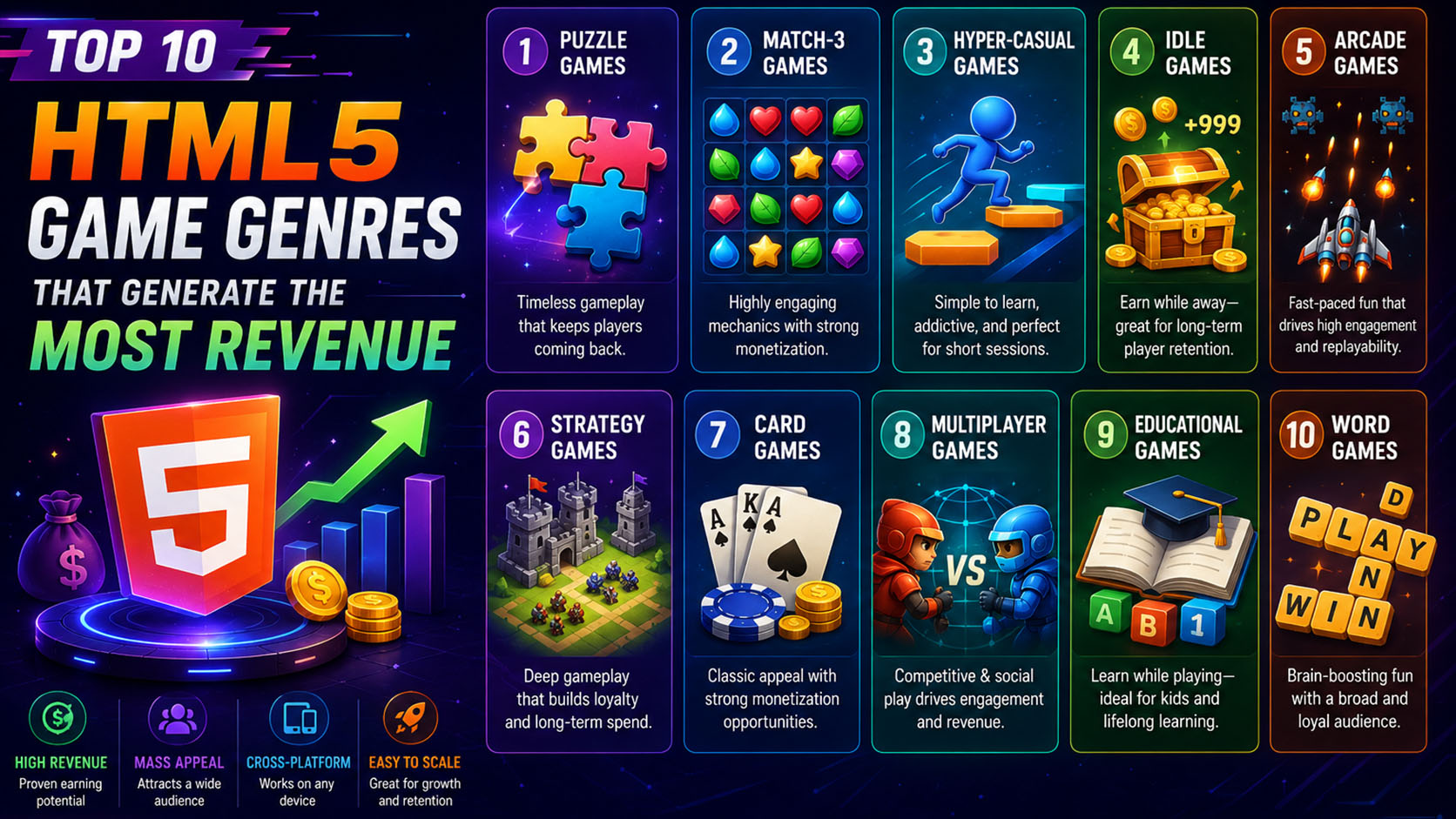
Introduction
Not all HTML5 games are created equal — at least not from a revenue perspective.
You can build two technically brilliant games and watch one quietly generate thousands of dollars a month while the other barely covers your coffee bill. The difference often has nothing to do with code quality or art style. It comes down to one fundamental choice made before a single line is written:
Genre.
Genre determines how long players stay. It shapes how many times they return. It influences how naturally advertising, in-app purchases, and rewarded mechanics fit into the experience. And ultimately, it dictates how much money a game can realistically generate.
In 2026, the HTML5 gaming ecosystem is more data-rich than ever. Portal analytics, ad network reports, and developer community data now give us a clearer-than-ever picture of which genres consistently outperform the rest.
This guide breaks down the top 10 HTML5 game genres by revenue potential — covering why each genre earns what it earns, how to monetize it effectively, the best examples to study, and who should actually build in each space.
Whether you're choosing your first project or expanding an existing portfolio, this is the genre intelligence you need.
Table of Contents
- Puzzle Games
- Match-3 Games
- Hyper-Casual Games
- Idle Games
- Arcade Games
- Strategy Games
- Card Games
- Multiplayer Games
- Educational Games
- Word Games
- Genre Revenue Comparison Summary
- How to Choose the Right Genre for You
- Conclusion
1. Puzzle Games {#puzzle-games}
Revenue Potential: ⭐⭐⭐⭐⭐
Monetization Fit: Rewarded Ads, Interstitials, IAP, Portal Licensing
Development Complexity: Low–Medium
Audience: All ages, all demographics
Puzzle games are the undisputed kings of the HTML5 game world — and they have been for years. They dominate game portal charts, generate exceptional ad revenue, and attract the broadest possible demographic cross-section. If you're looking for the single safest bet in HTML5 game development, puzzle is it.
Why Puzzle Games Generate So Much Revenue
The revenue advantage of puzzle games comes down to one magic ingredient: session loops.
Puzzle games are built on a simple, repeatable structure — present a challenge, let the player solve it, reward them, and immediately present the next challenge. This loop is engineered for extended play sessions. Players who enter intending to solve "just one more" puzzle routinely play for 20–40 minutes, generating multiple ad impression opportunities per session.
The short, discrete level structure also creates perfect natural breaks for advertising. Every level completion is a moment where an interstitial ad feels natural rather than intrusive. Rewarded video fits beautifully too — "Watch an ad to get a hint" is an exchange players genuinely appreciate.
Monetization Strategy for Puzzle Games
- Interstitial ads between levels (every 2–3 levels is the sweet spot)
- Rewarded video for hints, extra attempts, and skip-level mechanics
- Level packs as premium IAP — sell sets of 50–100 new puzzles for $0.99–$2.99
- Portal licensing — puzzle games are consistently the most in-demand genre on GameDistribution and CrazyGames
Top Examples to Study
- 2048 (number sliding puzzle)
- Cut the Rope (physics puzzle)
- Mahjong Solitaire (tile matching)
- Flow Free (connection puzzle)
- Sudoku variants
Who Should Build Puzzle Games
Puzzle games are ideal for solo developers and small teams. Their visual requirements are modest, their game logic is well-understood, and the genre has enormous template variety — from sliding puzzles and physics-based challenges to logic puzzles and spatial reasoning games. Almost every sub-genre remains commercially viable.
Revenue Insight: A well-optimized puzzle game on CrazyGames and GameDistribution combined can realistically generate $800–$3,000+ per month in advertising revenue alone, with licensing fees adding significant upside.
2. Match-3 Games {#match-3-games}
Revenue Potential: ⭐⭐⭐⭐⭐
Monetization Fit: Rewarded Ads, IAP, Sponsorships
Development Complexity: Medium
Audience: 25–55, predominantly female
Match-3 is one of the most commercially proven game genres in the entire gaming industry — not just HTML5. Candy Crush Saga alone generated over $20 billion in lifetime revenue. While HTML5 match-3 games obviously operate at a different scale, the genre's underlying monetization mechanics translate powerfully to the browser.
Why Match-3 Is a Revenue Powerhouse
Match-3 games achieve something most genres struggle with: emotional investment in progression. Players don't just play match-3 games — they advance through them. The combination of incremental difficulty, visual reward systems (exploding tiles, cascading matches, level completion animations), and a constant drip of "almost won" moments creates a psychological loop that drives unusually high session times and return visit rates.
High return rates mean high lifetime value per player — and high lifetime value is exactly what makes match-3 such a strong monetization vehicle.
Monetization Strategy for Match-3 Games
- Rewarded video ads for extra moves when players are one move from victory — this is the most effective single rewarded ad placement in any genre
- Life systems — limit plays per session, use rewarded video or wait timers to refill (creates urgency and drives ad consumption)
- Power-up IAP — special bombs, color wipes, and row-clearing tools are natural premium purchases
- Seasonal content — holiday-themed levels and cosmetic boards drive engagement spikes and sponsorship opportunities
Top Examples to Study
- Candy Crush (the benchmark — study it obsessively)
- Jewel Blast
- Bubble Shooter variants
- Bejeweled
- Farm Heroes Saga (Facebook/browser version)
Who Should Build Match-3 Games
Match-3 games require more development investment than basic puzzle games — particularly in the visual feedback department. Satisfying particle effects, smooth animations, and polished sound design are not optional in this genre; they're expected by players. Teams with a strong artist or access to premium asset packs are better positioned here.
Revenue Insight: Match-3 games have the highest rewarded video engagement rates of any HTML5 genre. Players in the moment of "one move away from winning" convert on rewarded video at rates of 60–80%, generating premium CPMs at exceptional frequency.
3. Hyper-Casual Games {#hyper-casual-games}
Revenue Potential: ⭐⭐⭐⭐
Monetization Fit: Interstitials, Rewarded Ads, Playable Ads
Development Complexity: Very Low
Audience: All ages, casual players, mobile-first users
Hyper-casual is the genre that rewrote the economics of mobile gaming — and its principles translate directly and powerfully to HTML5 browser gaming.
What Defines Hyper-Casual
Hyper-casual games have three defining characteristics:
- One-tap or one-swipe mechanics — the entire game is controlled with a single input
- Immediately understandable — a new player grasps the concept within 3 seconds, no tutorial required
- Addictive difficulty progression — easy to start, maddeningly difficult to master
Think Flappy Bird, Stack, Helix Jump, and Color Road. These games are so simple they look like they took 20 minutes to build. The best ones took 2–4 weeks — and some have generated millions of dollars.
Why Hyper-Casual Dominates Ad Revenue
The hyper-casual model is fundamentally different from most genres. Instead of maximizing revenue per session, it maximizes volume — vast numbers of players playing short sessions, with aggressive but non-intrusive advertising woven throughout.
Because the game loop is so short (most sessions end within 30–90 seconds), interstitial ads between rounds don't feel disruptive — they feel like natural pauses. A player who dies 20 times in 10 minutes has generated 10–15 ad impression opportunities. At scale, that's extremely valuable.
Monetization Strategy for Hyper-Casual Games
- High-frequency interstitials — show an ad after every 2–3 rounds; short sessions make this feel normal
- Rewarded video for revives — "Watch an ad to continue from your score" is hyper-casual's killer rewarded placement
- Leaderboards — drive return visits and competitive social sharing without any monetization cost
- Playable ads — hyper-casual games are the perfect playable ad format because the entire game fits in a 30-second demo
Top Examples to Study
- Flappy Bird (the original viral template)
- Color Road
- Stack Jump
- Zigzag
- Knife Hit
Who Should Build Hyper-Casual Games
Hyper-casual is the best genre for first-time HTML5 developers. The mechanics are simple to implement, the visual requirements are minimal (geometric shapes and bold colors often work better than complex art), and the development cycle is fast — a new hyper-casual game can realistically go from concept to published in 2–4 weeks.
Revenue Insight: Individual hyper-casual games earn less per player than deeper genres — but the speed of development means developers can build and publish 8–12 titles per year, creating a portfolio that collectively generates substantial passive income.
4. Idle Games {#idle-games}
Revenue Potential: ⭐⭐⭐⭐⭐
Monetization Fit: Rewarded Ads, IAP, Long-Term Engagement Loops
Development Complexity: Medium
Audience: 18–40, strategy-inclined players
Idle games — also called clicker games or incremental games — are one of the most fascinating and underrated revenue generators in the HTML5 space. Players click (or simply wait) to accumulate resources, which they spend on upgrades that generate more resources automatically. That's it. And yet, people play for hours.
The Idle Game Revenue Paradox
Idle games seem like they shouldn't work from a monetization standpoint. Players can walk away for hours and return to find progress waiting for them. There's no urgency, no skill ceiling, no real challenge.
And yet idle games generate exceptional revenue — because they're optimized for something uniquely valuable: time investment.
The longer a player plays an idle game, the more invested they become. The game tracks their accumulated resources, their upgrade trees, their prestige counts. Walking away means losing a sense of progress. This psychological investment drives:
- Unusually long session times when players are active
- High return rates (players check in multiple times per day)
- Strong rewarded video adoption — "Watch an ad to 2x your offline earnings" is the most compelling rewarded video offer in any genre
Monetization Strategy for Idle Games
- Offline earnings multiplier via rewarded video — the single most effective rewarded video placement in HTML5 gaming; players who've been away for 4 hours are highly motivated to double what they earned while offline
- Speed boost via rewarded video — "Watch an ad to produce resources 10x faster for 1 hour"
- Premium upgrades as IAP — special buildings, permanent multipliers, or cosmetic prestige items
- Prestige system — "reset" mechanics that let players restart with permanent bonuses keep the game alive for months
Top Examples to Study
- Adventure Capitalist
- Cookie Clicker (the genre founder)
- Idle Miner Tycoon
- Clicker Heroes
- Egg, Inc.
Who Should Build Idle Games
Idle games reward developers with strong systems design skills over visual artists. The numbers, balancing, and upgrade tree design matter far more than pixel-perfect art. If you enjoy spreadsheet math, economy design, and progression systems, idle games are your genre.
Revenue Insight: Idle games have the highest rewarded video engagement rate relative to active playtime of any HTML5 genre, because the reward is directly tied to the game's core loop (more resources = more progress). Monthly revenues of $1,000–$5,000 are achievable for well-balanced idle titles on major portals.
5. Arcade Games {#arcade-games}
Revenue Potential: ⭐⭐⭐⭐
Monetization Fit: Interstitials, Rewarded Ads, Leaderboards, Portal Licensing
Development Complexity: Low–Medium
Audience: 13–35, competitive players, nostalgic adults
Arcade games are the heartbeat of browser gaming — they've been there from the beginning, they've never gone out of style, and they continue to generate reliable, consistent revenue on virtually every HTML5 portal.
Why Arcade Games Never Die
Arcade games tap into something primal: the human love of reaction-based challenge and the desire to see a high score climb. The core loop — play, fail, try again, do better — is the most fundamentally compelling loop in gaming. It's why Tetris is still being played 40 years after its creation.
In the HTML5 context, arcade games benefit from:
- High replay rates — players replay compulsively to beat their own scores
- Social sharing — leaderboards and score screenshots drive organic distribution
- Short sessions — which, as in hyper-casual, create frequent natural ad break opportunities
- Nostalgia factor — remakes and modernizations of classic arcade games consistently outperform original concepts on portals
Monetization Strategy for Arcade Games
- Interstitials between game sessions — each game-over is an opportunity; show an ad every 2–3 game-overs
- Rewarded video for revives — "Watch an ad to continue from where you died" works well for score-attack games
- Leaderboard-driven engagement — global and friend leaderboards drive daily return visits without monetization cost
- Exclusive portal licensing — arcade games are consistently high-value licensing targets for portals building their content catalog
Top Examples to Study
- Pac-Man browser recreations
- Asteroids variants
- Snake.io adaptations
- Geometry Dash-style rhythm games
- Space Invaders modernizations
Who Should Build Arcade Games
Arcade games are ideal for developers who want a fast development cycle with proven market demand. The gameplay systems are well-understood, the visual requirements are flexible (pixel art works beautifully for this genre), and the tutorial needs are minimal. A competent solo developer can build and publish a polished arcade game in 3–6 weeks.
Revenue Insight: Arcade games earn strong revenues from portal licensing in addition to advertising — many portals actively seek arcade titles to fill their "classic games" and "action" categories, creating licensing deal opportunities above and beyond ad revenue.
6. Strategy Games {#strategy-games}
Revenue Potential: ⭐⭐⭐⭐
Monetization Fit: IAP, Rewarded Ads, Long-Session Advertising, Licensing
Development Complexity: High
Audience: 20–45, analytical and competitive players
Strategy games represent the high-investment, high-reward corner of the HTML5 market. They're harder to build, harder to balance, and harder to market — but players who love them are among the most engaged and highest-monetizing in all of browser gaming.
Why Strategy Players Are High-Value
Strategy game players exhibit behavioral traits that advertisers and monetization systems love:
- Extremely long sessions — it's common for strategy players to spend 30–90 minutes in a single sitting
- High cognitive investment — because they're solving complex problems, they're mentally engaged in a way that passive content consumption doesn't achieve
- Strong return habits — turn-based and base-building strategy games create persistent states that players return to repeatedly over days and weeks
- Higher willingness to pay — strategy players are more likely than casual gamers to make in-game purchases to gain a competitive edge or accelerate progression
Subcategories and Monetization
Tower Defense The most accessible strategy subcategory for HTML5. Short-to-medium sessions, clear win/lose states, and natural interstitial placement between waves make tower defense excellent for advertising revenue.
Turn-Based Strategy Longer sessions, deeper engagement. Better suited for IAP monetization (extra units, special abilities, premium campaigns) than pure advertising.
Real-Time Strategy (RTS) The most complex to build but commands the deepest player engagement. Multiplayer RTS games in the browser have a dedicated, underserved audience. Monetize through cosmetics, ranked mode access, and seasonal passes.
Base Building / City Building Idle-adjacent. Players build and return. Excellent for rewarded ad mechanics tied to build timers. Think browser-based Clash of Clans mechanics.
Top Examples to Study
- Kingdom Rush (tower defense benchmark)
- Bloons Tower Defense (HTML5 version)
- Mindustry
- Forge of Empires (browser version)
- Shellshock Live
Revenue Insight: Strategy games generate lower advertising revenue per session count than casual genres — but their exceptional session lengths mean each player generates more ad impressions per visit, and their higher-than-average IAP conversion rates add meaningful revenue on top.
7. Card Games {#card-games}
Revenue Potential: ⭐⭐⭐⭐
Monetization Fit: Interstitials, IAP (card packs), Sponsorships, Portal Licensing
Development Complexity: Low–Medium
Audience: All ages, broad demographic appeal
Card games are one of the most quietly profitable categories in HTML5 gaming — consistently underrated by developers and consistently beloved by players. From Solitaire to Poker to collectible card game (CCG) formats, the genre has extraordinary demographic breadth and a long history of robust monetization.
The Solitaire Effect
Solitaire is statistically one of the most-played browser games in history — and it's not close. Studies have shown that Solitaire variants account for an enormous share of total browser game sessions globally. Why? Because the audience is everyone — children, adults, seniors, office workers killing 10 minutes during a break, retirees spending an afternoon. The demographic is as wide as the internet itself.
This breadth creates reliable, predictable advertising revenue at scale. A well-executed Solitaire game published across GameDistribution's network can generate tens of thousands of plays per day with virtually no marketing spend.
Collectible Card Games: The Premium Tier
At the other end of the card game spectrum, collectible card games (CCGs) offer the richest monetization architecture in the entire genre:
- Card pack IAP — the fundamental CCG monetization model; players purchase randomized card packs to build stronger decks
- Battle pass — seasonal premium tracks with exclusive cards and cosmetics
- Ranked mode access — freemium access to casual play, premium subscription for ranked competition
- Cosmetic purchases — card backs, deck themes, player avatars
CCGs require significantly more development investment but can generate the highest per-player revenue of any card game subgenre.
Monetization Strategy for Card Games
- Traditional card games (Solitaire, Poker, Blackjack): interstitial ads between games; banner ads on desktop; portal licensing
- CCGs and deck-builders: card pack IAP, seasonal passes, cosmetic purchases
- Sponsored card backs and table themes: excellent, non-intrusive sponsorship integration opportunity
Top Examples to Study
- Classic Solitaire Klondike
- FreeCell
- Hearthstone (the CCG benchmark — study its economy)
- Yu-Gi-Oh! browser adaptations
- Legends of Runeterra (web version)
Revenue Insight: Traditional card games (Solitaire, Poker) generate exceptional portal licensing fees because of their proven, massive player bases. CCG formats offer the highest per-player IAP revenue of any card game type, often comparable to match-3 games in monthly revenue potential.
8. Multiplayer Games {#multiplayer-games}
Revenue Potential: ⭐⭐⭐⭐⭐
Monetization Fit: IAP (cosmetics), Rewarded Ads, Subscriptions, Tournaments
Development Complexity: High
Audience: 13–35, competitive and social players
Multiplayer HTML5 games occupy a unique position in the market: they're the hardest to build, but they're also the category most likely to generate viral organic growth — which translates directly into explosive, sustainable revenue.
The Network Effect Advantage
Every player who joins a multiplayer game and enjoys it becomes a recruiter. They invite friends, post clips, share scores, and talk about the game. The game's player base grows organically, without paid marketing. This network effect is why .io games — the HTML5 multiplayer category that exploded with Agar.io and Slither.io — have generated some of the most dramatic success stories in browser gaming history.
Agar.io, a multiplayer browser game built by a single developer in 3 days, reached 100,000 concurrent players within weeks of launch. No marketing budget. No press outreach. Pure viral organic growth powered by the network effect.
.io Games: The Multiplayer HTML5 Blueprint
The .io game format is the dominant multiplayer template in HTML5 gaming:
- Simple mechanics, instantly understandable
- Real-time competition with other human players
- Persistent leaderboard showing top players globally
- No account required to start playing
This formula has generated dozens of profitable games: Agar.io, Slither.io, Diep.io, Krunker.io, Shell Shockers, and many more. Each has served millions of players and generated substantial advertising and cosmetic revenue.
Monetization Strategy for Multiplayer Games
- Cosmetic IAP — skins, hats, colors, trails, and other visual customizations with no gameplay advantage. This is the gold standard for competitive multiplayer monetization because it earns revenue without creating pay-to-win dynamics that destroy competitive communities
- Rewarded video for revives — in battle royale or last-player-standing formats, a single ad for one extra life is a high-converting placement
- Season passes — monthly cosmetic progression tracks that incentivize recurring spending
- Tournament entry fees — competitive events where players pay to compete for prizes; platforms like Skillz facilitate this
Technical Considerations
Multiplayer requires server-side infrastructure — WebSocket servers for real-time games or polling servers for turn-based. This infrastructure cost is the primary barrier. Solutions:
- Colyseus — open-source, HTML5-optimized multiplayer framework
- Socket.io — widely used WebSocket library
- Photon Engine — managed multiplayer backend with generous free tier
- PieSocket — affordable WebSocket hosting for indie developers
Revenue Insight: Successful multiplayer games generate revenue curves that no other HTML5 genre can match — exponential growth as player counts rise, sustained by cosmetic IAP ecosystems. The development investment is high, but the ceiling is the highest of any genre on this list.
9. Educational Games {#educational-games}
Revenue Potential: ⭐⭐⭐⭐
Monetization Fit: B2B Licensing, Subscriptions, Institutional Sales, Sponsorships
Development Complexity: Medium
Audience: Children (4–16), parents, teachers, school institutions
Educational games — or "edutainment" — represent a fundamentally different business model from entertainment-focused HTML5 genres. The audience is different, the distribution channels are different, and the monetization strategies are different. But the revenue opportunity is very real, and in some ways more predictable and defensible than consumer gaming.
Why Educational Games Are Different (and Why That's Valuable)
Educational games don't primarily monetize through advertising. In fact, advertising-based monetization is often inappropriate or prohibited in educational contexts, especially for children under 13 (COPPA regulations in the US; GDPR-K in the EU).
Instead, educational games monetize through institutional and subscription channels — which tend to generate far more revenue per sale than individual advertising impressions:
- School/district licensing — a single district license can generate $5,000–$50,000+ per year
- Platform partnerships — educational platforms like Khan Academy, Prodigy, ABCmouse, and Starfall license third-party game content
- Parent-facing subscriptions — premium content access on a monthly or annual basis
- App-as-curriculum — games built to align with national education standards (Common Core, NCERT, etc.) that schools can adopt as supplemental curriculum materials
The EdTech Market Opportunity in 2026
The global EdTech market was valued at over $200 billion in 2024 and continues to grow rapidly, driven by:
- Post-pandemic normalization of digital learning tools in classrooms
- Strong government investment in educational technology globally
- Growing parent demand for screen time that is productive and educational
- The expansion of homeschooling communities who actively seek quality educational software
HTML5 is particularly well-suited for education because it requires no installation — a teacher can share a URL and every student can play immediately, on any device, in any browser.
Monetization Strategy for Educational Games
- Freemium model — limited content free; full curriculum access via subscription ($4.99–$14.99/month per family)
- Institutional licensing — approach school boards, EdTech platform companies, and district IT departments directly
- Content packs — sell additional grade levels, subject areas, or difficulty packs as one-time purchases
- White-label licensing — allow tutoring companies, learning apps, and ed platforms to rebrand and deploy your game within their product
Top Examples to Study
- Prodigy Math (subscription model benchmark)
- Kahoot! (engagement mechanic benchmark)
- Coolmath Games (advertising + subscription hybrid)
- ABCmouse (subscription + curriculum alignment)
- Duolingo (gamification and streak mechanics)
Revenue Insight: A single institutional licensing deal for an educational HTML5 game can generate more revenue than 6–12 months of portal advertising for an entertainment game. The B2B sales cycle is longer, but the contract values are dramatically higher.
10. Word Games {#word-games}
Revenue Potential: ⭐⭐⭐⭐
Monetization Fit: Interstitials, Rewarded Ads, IAP, Portal Licensing
Development Complexity: Low
Audience: 25–65, language enthusiasts, puzzle fans, casual players
Word games are the sleeping giant of HTML5 gaming monetization. Often overlooked in conversations about revenue-generating genres, word games quietly deliver some of the highest CPMs and most loyal repeat audiences in browser gaming.
The Word Game Renaissance
Wordle changed everything. When Josh Wardle's simple browser-based word guessing game went viral in late 2021, it reminded the entire games industry of something that was always true: word games have enormous untapped mass-market potential.
Since then, the word game genre in HTML5 has exploded:
- Dozens of Wordle variants now generate substantial advertising revenue
- Classic word games like Scrabble-style builders and crosswords have seen major traffic spikes on game portals
- New hybrid formats mixing word mechanics with roguelike or puzzle elements have emerged as premium sub-genres
Why Word Game Players Are High-Value
Word game players skew older than most browser gaming demographics — typically 30–65 — and this age demographic is highly valuable from an advertising perspective. Advertisers pay premium CPMs to reach adults with established spending power, and word game audiences deliver exactly that.
Additionally, word game players exhibit exceptional loyalty. Someone who establishes a daily crossword or Wordle habit returns every single day. Daily active users mean daily ad impressions, which compounds into disproportionately high lifetime value per player.
Monetization Strategy for Word Games
- Interstitials between puzzles — daily puzzle games create a perfect natural break for advertising after each completed puzzle
- "Remove ads" IAP — word game players have the highest conversion rate for ad-free subscription offers of any casual genre, because they play daily and find repeated ad interruptions particularly bothersome
- Hint systems via rewarded video — "Watch an ad to reveal a letter" or "Watch an ad to check your answers" are high-converting placements
- Seasonal and themed puzzle packs — holiday crosswords, themed vocabulary challenges, and limited-time puzzle events as premium IAP
Top Examples to Study
- Wordle (and its endless official and unofficial variants)
- Scrabble Go (browser version monetization model)
- New York Times Spelling Bee (subscription benchmark)
- Crossword puzzle browsers
- Word Search generators
Who Should Build Word Games
Word games are one of the lowest technical barriers to entry of any HTML5 genre. The core mechanics — letter input, word validation against a dictionary, score calculation — are straightforward to implement. The challenge is in content design (puzzle curation, difficulty calibration) rather than programming. Writers, educators, and language enthusiasts with basic coding skills can thrive here.
Revenue Insight: Word games have the highest "remove ads" subscription conversion rate of any HTML5 genre — often 2–5% of daily active players — and that subscription revenue is extraordinarily consistent month over month because daily habit players churn at very low rates.
Genre Revenue Comparison Summary {#genre-comparison}
#
Genre
Revenue Potential
Best Monetization
Dev Complexity
Target Audience
1
Puzzle Games
⭐⭐⭐⭐⭐
Rewarded ads, licensing
Low–Medium
All ages
2
Match-3 Games
⭐⭐⭐⭐⭐
Rewarded video, IAP
Medium
25–55
3
Hyper-Casual
⭐⭐⭐⭐
High-freq interstitials
Very Low
All ages
4
Idle Games
⭐⭐⭐⭐⭐
Rewarded ads, IAP
Medium
18–40
5
Arcade Games
⭐⭐⭐⭐
Interstitials, licensing
Low–Medium
13–35
6
Strategy Games
⭐⭐⭐⭐
IAP, long-session ads
High
20–45
7
Card Games
⭐⭐⭐⭐
IAP, portal licensing
Low–Medium
All ages
8
Multiplayer Games
⭐⭐⭐⭐⭐
Cosmetic IAP, seasons
High
13–35
9
Educational Games
⭐⭐⭐⭐
B2B licensing, subs
Medium
4–16 + parents
10
Word Games
⭐⭐⭐⭐
"Remove ads" IAP, rewarded
Low
25–65
How to Choose the Right Genre for You {#how-to-choose}
With ten strong genres on the table, how do you decide where to invest your development time? Here's a simple decision framework:
If you want the fastest path to revenue: → Build a Hyper-Casual or Puzzle game. Low development complexity, proven market demand, fast portal acceptance, immediate advertising revenue.
If you want the highest per-game revenue ceiling: → Build a Multiplayer or Idle game. Higher development investment, but the revenue potential is significantly greater than any casual genre.
If you want the most predictable, sustainable income: → Build a Word Game or Card Game. Loyal daily audiences generate consistent ad revenue and have the highest "remove ads" subscription conversion rates.
If you have access to educational markets or institutional networks: → Build an Educational Game. The B2B revenue per sale is dramatically higher than consumer-facing advertising revenue.
If you want to build a portfolio quickly: → Build multiple Hyper-Casual and Arcade games. Low dev time per game means you can ship 8–12 titles per year, building passive income across a diversified portfolio.
If you have a strong art team: → Build Match-3 or Strategy games. These genres reward visual polish with higher player retention and better monetization outcomes.
Conclusion {#conclusion}
Genre is not a creative afterthought — it's a business decision. The genres on this list aren't popular by accident. They generate disproportionate revenue because they're engineered, intentionally or otherwise, to align with the ways players naturally engage with games: progressing through challenges, competing with others, learning something new, or simply satisfying a daily habit.
The best genre for you sits at the intersection of three things:
- Market demand — is there a proven audience for this genre on HTML5 portals?
- Your development strengths — does this genre play to your skills in art, systems design, or coding?
- Monetization fit — does this genre support the revenue model you want to build?
Get that intersection right, and you're not just building a game. You're building a revenue engine.
Pick your genre. Build with intention. Monetize intelligently.
Frequently Asked Questions (FAQ)
Q: What is the most profitable HTML5 game genre overall?
A: Puzzle, Match-3, and Idle games consistently top revenue charts because of their strong rewarded video engagement, high session times, and broad demographic appeal. Multiplayer games have the highest ceiling but require significantly more development investment.
Q: Which HTML5 game genre is best for beginners?
A: Hyper-Casual and Word games offer the lowest development complexity while still generating real advertising revenue. These genres are ideal for developers learning HTML5 game development while building a monetizable portfolio.
Q: Can a solo developer compete in high-complexity genres like Strategy or Multiplayer?
A: Yes, but it takes longer. Solo developers have built successful strategy and multiplayer HTML5 games — but timeline expectations should be 6–18 months of dedicated development rather than weeks. Game engines like Godot and Phaser significantly reduce the solo development burden.
Q: How important is genre for portal acceptance on CrazyGames or GameDistribution?
A: Genre matters less than quality and originality on most major portals. However, puzzle, arcade, and casual genres have the highest acceptance rates because they consistently perform well across all player demographics.
Q: Should I follow genre trends or build what I'm passionate about?
A: The most sustainable answer is both. Choose a revenue-proven genre (from this list), then find a creative angle within that genre that genuinely excites you. Developers who are passionate about their game build better products — and better products generate more revenue, regardless of genre.
Enjoyed this breakdown? Share it with a developer friend and explore our full HTML5 game development and monetization series for everything you need to build, publish, and profit from browser games in 2026.
Comments (0)