
Introduction
Remember the golden era of Flash games? Addictive little titles like Stick War, Bloons Tower Defense, and Happy Wheels defined a generation of casual gaming. Then, almost overnight, Adobe Flash was gone — officially discontinued on January 1, 2021 — and with it, millions of browser games vanished into digital history.
But the story of browser gaming didn't end there. It evolved.
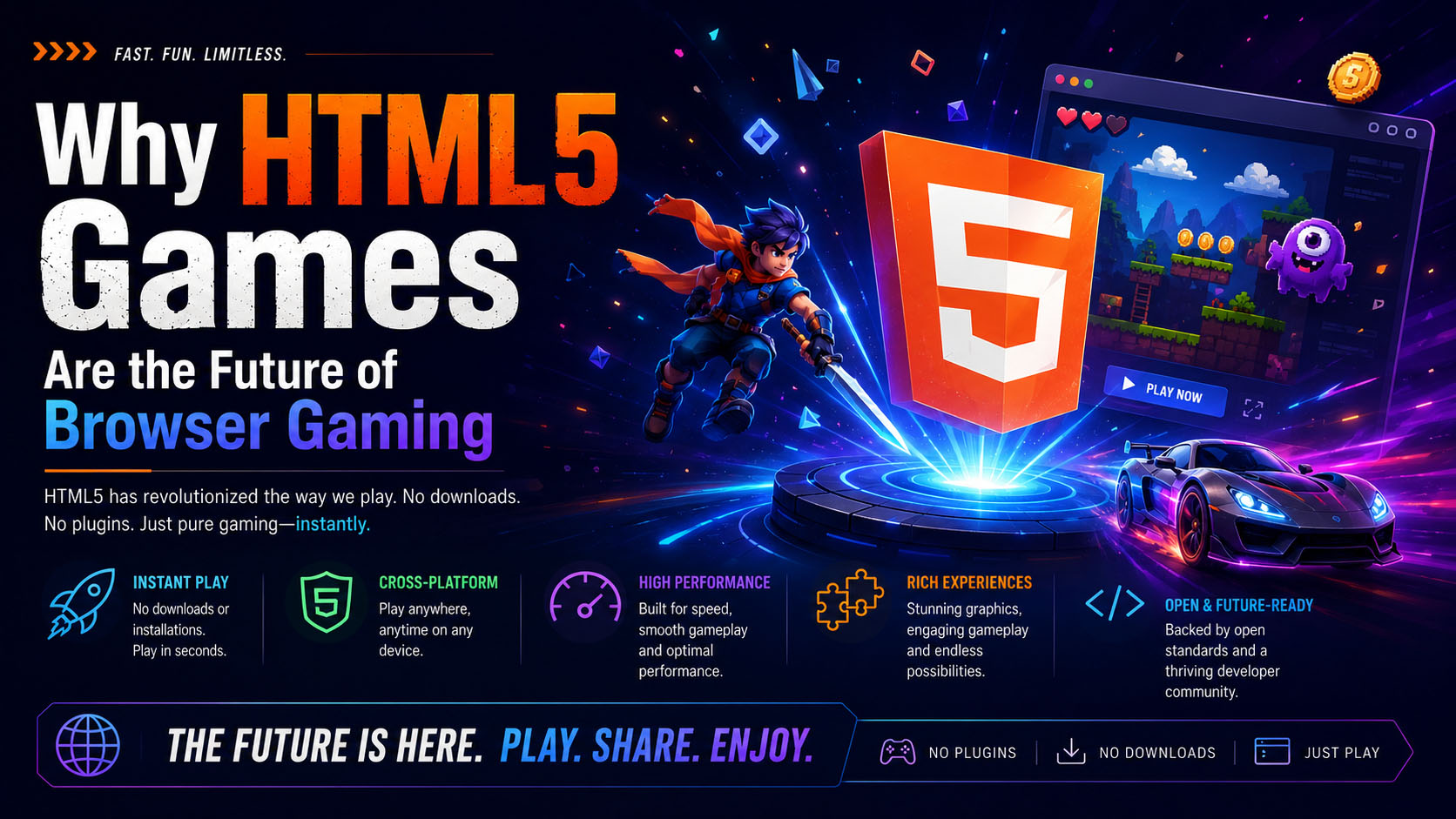
Enter HTML5 — the open, powerful, and future-proof standard that is not just replacing Flash, but actively redefining what browser gaming can be. In 2025, HTML5 games are everywhere: on smartphones, tablets, laptops, smart TVs, and even gaming consoles. And this is just the beginning.
Whether you're a game developer, a publisher, a brand marketer, or simply a gaming enthusiast, this guide breaks down exactly why HTML5 games are the undisputed future of browser gaming.
Table of Contents
- HTML5 vs Flash: The End of an Era and the Rise of a New One
- Cross-Platform Compatibility: Play Anywhere, on Any Device
- No Downloads Required: The Instant-Play Advantage
- Growing Market Opportunities for Developers and Publishers
- Monetization Options: How HTML5 Games Make Money
- The Road Ahead: What's Next for HTML5 Gaming
- Conclusion
1. HTML5 vs Flash: The End of an Era and the Rise of a New One {#html5-vs-flash}
To understand why HTML5 is transformative, you first need to understand why Flash had to go.
The Fall of Flash
Adobe Flash was a powerhouse in its prime, but it was plagued by deep-rooted problems that became impossible to ignore:
- Security vulnerabilities: Flash was notoriously riddled with security loopholes. It ranked among the most exploited technologies on the web for over a decade, making it a prime vector for malware and cyberattacks.
- Performance issues: Flash was a resource hog. It drained laptop batteries, crashed browsers, and caused overheating — problems that became glaring as mobile devices took over.
- No mobile support: Apple's Steve Jobs famously refused to allow Flash on iOS in 2010. With Android eventually following suit, Flash was effectively locked out of the mobile web.
- Proprietary and closed: Flash required a third-party plugin. It was owned by a single company, creating a dependency that the entire web industry was uncomfortable with.
- Poor accessibility: Flash content was nearly invisible to search engines and screen readers, making it both an SEO nightmare and an accessibility failure.
Why HTML5 Wins
HTML5, in contrast, was built as an open web standard — developed collaboratively by the W3C and browser vendors with the explicit goal of making the web richer without plugins.
Here's what makes HTML5 fundamentally superior for gaming:
Feature
Flash
HTML5
Plugin required
✅ Yes
❌ No
Mobile support
❌ No
✅ Full
Security
⚠️ Frequent exploits
✅ Sandboxed & secure
Battery efficiency
❌ Poor
✅ Optimized
SEO indexable
❌ No
✅ Yes
Open standard
❌ No
✅ Yes
Modern GPU support
❌ Limited
✅ Full (WebGL/WebGPU)
With technologies like Canvas API, WebGL, WebGPU, Web Audio API, and WebAssembly (WASM), HTML5 can render complex 3D graphics, spatial audio, and physics simulations that rival native mobile games. Game engines like Phaser, Three.js, Babylon.js, and Unity WebGL have made building polished, high-performance HTML5 games more accessible than ever.
Key Takeaway: HTML5 isn't just a Flash replacement — it's a generational leap forward that enables richer, safer, and faster gaming experiences across every modern platform.
2. Cross-Platform Compatibility: Play Anywhere, on Any Device {#cross-platform-compatibility}
One of HTML5's most powerful traits — and perhaps its most commercially significant — is its inherent cross-platform compatibility.
Write Once, Play Everywhere
With HTML5, a game built once can run seamlessly across:
- Desktop browsers (Chrome, Firefox, Edge, Safari)
- Mobile browsers (iOS Safari, Android Chrome)
- Tablets
- Smart TVs with a browser
- Chromebooks
- Gaming consoles with integrated browsers (PlayStation, Xbox)
This is a seismic shift compared to the traditional app-store model, where a developer must maintain separate codebases for iOS, Android, and PC — each requiring its own build pipeline, store approval process, and update cycle.
Responsive Design + Touch Support
HTML5 games can be designed to be fully responsive, adapting their layouts and controls to different screen sizes automatically. Touch input is natively supported, allowing the same game to use keyboard controls on desktop and swipe/tap controls on mobile — without rewriting a single line of game logic.
The Developer Efficiency Advantage
For indie developers and small studios, cross-platform HTML5 development dramatically lowers costs:
- No separate mobile builds — saving weeks of development time
- No app store fees — Apple and Google take 15–30% of app revenue; HTML5 games distributed on the web bypass this entirely
- Faster iteration — update your game on the server and all players get the latest version instantly, with no approval delays
Real-World Example
A casual puzzle game built in Phaser 3 can be published on game portals like CrazyGames, Poki, and itch.io, embedded as a widget on a brand's website, converted to a mobile app with a lightweight wrapper like Cordova or Capacitor, and licensed to third-party platforms — all from a single HTML5 codebase. That's the power of cross-platform compatibility.
Key Takeaway: HTML5's cross-platform nature means more players, lower development costs, and faster time-to-market — a trifecta that no other gaming technology currently matches.
3. No Downloads Required: The Instant-Play Advantage {#no-downloads-required}
We live in an age of instant gratification. Attention spans are shrinking, and the gaming industry has adapted accordingly.
The Friction Problem
Every step between a player discovering a game and actually playing it is a point where you lose them. The traditional PC/console gaming model involves:
- Visit a store page
- Click "Download"
- Wait (sometimes for hours)
- Install
- Accept permissions
- Create/log in to an account
- Finally play
That's seven steps before a single frame is rendered. With HTML5 games, that process collapses to:
- Click a link
- Play
Instant Play = Higher Engagement
The data backs this up. Browser-based and instant-play games consistently show:
- Higher click-through rates on ads and social media promotions
- Lower abandonment rates during onboarding
- Broader demographic reach (casual players who wouldn't normally download an app are happy to click and play)
This is why platforms like Facebook Instant Games, Snapchat Mini Games, and YouTube Playables have all bet on HTML5 — because instant play converts curiosity into engagement at a scale that download-required games simply cannot.
Progressive Loading: Best of Both Worlds
Modern HTML5 games can use progressive loading — showing an initial playable scene in seconds while loading additional assets in the background. This gives players the instant-play feel while quietly preparing the full experience behind the scenes.
Additionally, Progressive Web App (PWA) technology allows HTML5 games to be "installed" from the browser with a single tap, adding an icon to the home screen and enabling offline play — all without touching an app store.
Key Takeaway: Zero-friction, instant-play experiences reduce player drop-off and dramatically expand a game's potential audience, especially among casual and mobile-first players.
4. Growing Market Opportunities for Developers and Publishers {#growing-market-opportunities}
The HTML5 gaming market is not just surviving — it's booming.
Market Size and Growth
The global HTML5 games market was valued at approximately $7 billion in 2023 and is projected to exceed $20 billion by 2030, growing at a compound annual growth rate (CAGR) of around 14–16%. Key drivers include:
- The explosive growth of mobile-first internet users in emerging markets like India, Southeast Asia, and Africa
- The rise of casual and hyper-casual gaming demographics
- Increased interest from brands and advertisers in playable content
- The growth of cloud gaming and browser-based platforms
- The decline of the native app as the default delivery mechanism
Game Portals and Licensing Opportunities
One of the most lucrative and underrated opportunities in HTML5 gaming is the game licensing model. Platforms like:
- CrazyGames (100M+ monthly players)
- Poki (50M+ monthly players)
- Coolmath Games
- Miniclip
- GameDistribution
...license HTML5 games from developers and share advertising revenue. A single well-performing HTML5 game can generate thousands of dollars per month in passive licensing revenue from just a handful of portals.
Branded and Serious Games
Companies are increasingly investing in branded HTML5 mini-games as a marketing and engagement tool. A branded game embedded on a website:
- Increases average session duration
- Builds brand affinity, especially among younger audiences
- Drives social sharing and organic reach
- Can be deployed without any app store involvement
From fast-food chains running loyalty reward games to e-commerce platforms embedding slot-style spin-to-win mechanics, branded HTML5 games have become a multi-million dollar sub-industry.
Emerging Opportunities: Web3 and EdTech
Beyond traditional gaming, HTML5 is powering:
- Play-to-earn and Web3 games — blockchain-integrated browser games that don't require downloads or special wallets
- EdTech gamification — educational games deployed directly in school LMS platforms and browsers
- Corporate training simulations — interactive, game-like training tools accessible via any browser
Key Takeaway: The HTML5 gaming market is growing rapidly across multiple verticals — from consumer gaming portals to branded experiences and educational platforms — creating diverse revenue streams for developers.
5. Monetization Options: How HTML5 Games Make Money {#monetization-options}
One of the most common misconceptions about HTML5 games is that they're hard to monetize. In reality, HTML5 games have more monetization levers than almost any other format.
1. In-Game Advertising
Display advertising is the most common monetization method on HTML5 game portals. Types include:
- Interstitial ads — full-screen ads shown between game levels or on game-over screens
- Rewarded video ads — players voluntarily watch a video in exchange for in-game rewards (extra lives, coins, power-ups). This format has the highest engagement rates and is deeply popular in HTML5 games.
- Banner ads — displayed around the game frame; lower engagement but passive revenue
- Playable ads — the HTML5 game itself is used as an interactive ad unit, commanding significantly higher CPMs than standard formats
Networks like Google AdSense, Gamedistribution SDK, and CrazyGames SDK make it straightforward to integrate these ad types.
2. Licensing and White-Labeling
Developers can license their HTML5 games to:
- Game portals (non-exclusive licensing = multiple revenue streams simultaneously)
- Brands wanting custom-branded versions of existing games
- Advertisers using the game as a playable ad
- Schools and educational platforms
Licensing fees range from one-time payments to revenue-sharing deals, with some popular titles earning $500–$5,000+ per license.
3. In-App Purchases and Microtransactions
HTML5 games can implement in-game economies with:
- Cosmetic purchases — skins, avatars, themes
- Power-ups and consumables
- Battle passes or season passes
- Premium content unlocks
Payment can be handled through Stripe, PayPal, or integrated through platforms like Poki or CrazyGames, which offer their own virtual currency systems.
4. Subscriptions and Premium Access
Some HTML5 game platforms offer a subscription tier where players pay monthly for an ad-free experience or access to exclusive games. Developers earn a share of subscription revenue based on playtime — similar to how Spotify or Apple Music pays artists.
5. Tournaments and Competitive Play
Platforms like Skillz and Overwolf allow HTML5 game developers to integrate real-money tournaments, where players compete for cash prizes. The platform takes a cut; the developer earns a share of entry fees. This model is especially effective for skill-based games like puzzle, trivia, and arcade titles.
6. Sponsorships and Brand Deals
High-traffic HTML5 games can attract direct sponsorships from brands. A game with 500,000 monthly players is a meaningful advertising channel for the right brand — and sponsorship deals often pay far better than programmatic ad rates.
Key Takeaway: HTML5 games support a rich, layered monetization ecosystem — from advertising and licensing to subscriptions and tournaments — giving developers multiple ways to build sustainable revenue without being locked into any single platform or marketplace.
6. The Road Ahead: What's Next for HTML5 Gaming {#road-ahead}
The HTML5 gaming landscape in 2025 is already impressive, but the next few years promise to be transformational.
WebGPU: A Quantum Leap in Graphics
WebGPU, the successor to WebGL, is now supported in all major browsers and enables games to access the GPU in ways previously only possible in native apps. We're talking real-time ray tracing, advanced particle systems, and AAA-quality rendering — all inside a browser tab.
WebAssembly: Native Speed in the Browser
WebAssembly (WASM) allows game engines written in C++ (like Unity and Unreal Engine) to compile directly to the browser, running at near-native performance. This is closing the gap between browser games and console/PC titles at an astonishing rate.
AI-Driven Procedural Content
AI is beginning to power procedurally generated levels, adaptive difficulty, and dynamic NPC behavior in HTML5 games. This means endless replayability without massive content budgets — a huge advantage for small studios.
The Metaverse and Spatial Web
As the concept of persistent, interconnected virtual worlds matures, HTML5 is positioned as the delivery mechanism of choice — accessible, frictionless, and universally compatible.
7. Conclusion {#conclusion}
The future of browser gaming is not uncertain — it's HTML5, and it's already here.
Flash was a stepping stone; HTML5 is the destination. It delivers better security, universal device support, frictionless instant play, explosive market growth, and diverse monetization pathways. Whether you're an indie developer looking for your first release, a publisher seeking scalable licensing revenue, or a brand wanting to engage your audience in new ways, HTML5 games offer an unmatched combination of reach, accessibility, and commercial potential.
The browser was once seen as a limitation for gaming. In 2025, it's the most powerful distribution channel in the world.
The game has changed. HTML5 is how you win it.
Frequently Asked Questions (FAQ)
Q: Are HTML5 games as good as native mobile games?
A: For casual and mid-core games, absolutely. With WebGL and WebAssembly, even complex game genres run smoothly in the browser. AAA-level games still lean on native, but the gap is narrowing rapidly.
Q: Can HTML5 games work offline?
A: Yes. Using Progressive Web App (PWA) technology and Service Workers, HTML5 games can cache assets and run fully offline after the first load.
Q: How do HTML5 games make money without an app store?
A: Through advertising, licensing, in-game purchases, subscriptions, sponsorships, and tournament entry fees — all without paying the 15–30% cut that Apple and Google charge.
Q: What's the best engine for building HTML5 games?
A: Phaser 3 is the most popular open-source choice. Unity WebGL is excellent for more complex 3D games. Godot (with HTML5 export) and Construct 3 are also strong options depending on your skill level and project needs.
Q: Is HTML5 game development profitable in 2025?
A: Yes — particularly through portal licensing and branded game deals. The key is building for replayability, optimizing load times, and publishing across multiple platforms simultaneously.
Did you find this article helpful? Share it with your network and help spread the word about the exciting future of HTML5 browser gaming.
Comments (0)